

Best Practices in Olive Tree Landscaping

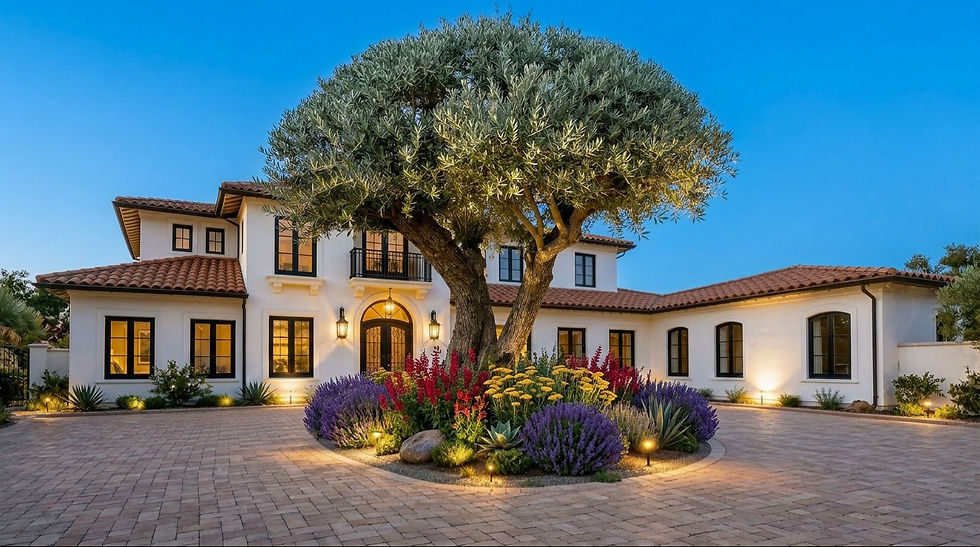
How do you position olive trees for beauty, balance, and long-term value? There’s a difference between planting a tree and placing it well. Most people don’t get this wrong because they lack effort. They get it wrong because they treat placement like an afterthought—something to figure out once everything else is in place.
But with olive trees, placement is the design.
Where you plant your tree determines how your entire yard feels—structured or scattered, intentional or unfinished. And when done right, landscaping with olive trees doesn’t just improve your yard—it transforms how your home is experienced.
If you’re wondering where olive trees actually belong in your yard, here are the placements that make the biggest impact. Here’s how to think about placement in a way that actually works.
Placing Olive Trees as Anchor Points
Every strong landscape has a point where the eye naturally settles. Without it, the space feels scattered. This is where olive trees excel. Their structure, trunk texture, and canopy create a natural focal point that anchors everything around them.
The key is placement with intention.
Look for:
A visual gap in your landscape
An area that feels undefined
A line of sight that lacks direction
Landscaping with olive trees in one of these spaces gives the yard a sense of grounding. Instead of everything competing for attention, the space begins to organize itself around a single, clear presence.
This is one of the most effective ways to begin landscaping with olive trees—not by adding more, but by placing one well.
Positioning Olive Trees for Natural Shade
Shade changes how a space is used. Too much, and it feels heavy. Too little, and the space becomes uncomfortable.
Olive trees strike a rare balance. Their canopies provide filtered light—enough to soften the sun without closing off the space.
To use this well, place olive trees:
Near seating areas
Adjacent to patios or gathering spaces
Where afternoon sun is strongest
Because the shade is diffused, it creates a comfortable environment without making the area feel enclosed. When you’re landscaping with olive trees for shade, think in terms of experience—not just coverage.
Where will people naturally want to sit, pause, or gather? That’s where the tree belongs.
Using Olive Trees to Create Visual Balance

A common issue in landscaping is imbalance. One side of a yard feels heavy. The other feels empty. Olive trees can correct that—but only when used thoughtfully. Balance doesn’t always mean symmetry. Instead, it’s about visual weight.
You can balance a space by:
Placing one mature olive tree opposite a denser planting area
Offsetting hardscape elements with organic structure
Using one tree to counteract multiple smaller elements
Because olive trees carry strong visual presence, they can balance more than their size suggests. This makes them incredibly versatile when landscaping with olive trees in complex layouts.
Allowing Olive Trees to Define Open Space
Empty space isn’t always a problem. But undefined space is. Olive trees are ideal for giving shape to areas that feel too open or unstructured. Instead of filling those areas with multiple plants, use a single tree to define the space.
This works especially well when:
A yard or patio feels too flat
There’s no clear sense of layout
The eye doesn’t know where to go
By placing an olive tree strategically, you create boundaries without building walls. The space feels intentional—even though it remains open. That’s one of the subtle strengths of landscaping with olive trees—they create structure without rigidity.
Framing Views with Olive Trees
Great landscapes don’t just exist—they guide what people see. Olive trees can be used to frame important views within your yard.
This could be:
The entrance to your home
A walkway or path
A seating area
A focal feature like a fountain or garden bed
By placing trees on either side—or slightly offset—you draw attention without forcing it. Because olive trees have an airy canopy, they frame without blocking. This keeps the space feeling open while still directing focus. When used this way, olive trees become part of the visual storytelling of your yard.
Giving Olive Trees Room to Stand Out
One of the biggest mistakes in planting olive trees is crowding them. It’s easy to underestimate their impact when they’re young. But over time, they expand—both physically and visually.
Olive trees need space to:
Develop their canopy
Show the detail of their trunk
Establish presence in the landscape
When surrounded too closely by other plants, they lose their defining quality. When given room, they become the feature.
Spacing isn’t just practical—it’s part of the design. If you’re serious about landscaping with olive trees, give them space to do what they’re meant to do.
Designing with the Future in Mind

Most landscaping decisions are made for how things look right now. But olive trees are long-term elements. They change. They grow. They develop character over time. So placement shouldn’t be based on the present—it should reflect where the space is going.
Ask yourself:
How will this tree look in five or ten years?
What will it interact with as it grows?
Will it enhance or compete with the space over time?
This shift in thinking is what separates short-term landscaping from long-term design. And olive trees reward that kind of planning more than most.
Summary of Landscaping With Olive Trees
Remember—a well-placed olive tree can do more than fill a gap. It can:
Anchor a space
Create comfort
Guide movement
Bring balance
That’s the difference between adding something to your yard…and designing it. Choosing where to plant an olive tree is important—but choosing the right tree matters just as much.
Not all olive trees are the same.
The shape, age, and structure of the tree will determine how well it functions as an anchor point, provides shade, or creates balance in your landscape. That’s why working with a small, specialized nursery can make a significant difference.
At 20th Century Olive Tree Nursery, the focus isn’t just on selling trees—it’s on helping you find one that fits your space and your vision.
Whether you’re:
Creating a focal point
Adding natural shade
Building a more intentional landscape
Having access to mature, well-shaped olive trees allows you to skip years of waiting and get the result you’re actually looking for. Find the place that needs structure, shade, or balance—and place it there.
Let that decision guide the rest.
(Images may be digitally enhanced or AI-generated for inspiration, illustrating how olive trees can enrich/transform different landscapes and spaces.)


Comments